

The Frustration of Diminishing Returns: How AI-Powered Fractional CMOs Unlock B2B SaaS Growth

Your team is using AI. Growth shouldn’t be THIS hard.
If it still is, the problem is not your tool but he gap between adoption and implementation. And in 2026, that gap is the most expensive line item on your P&L that does not appear on any report.
For PE-backed and mid-market B2B tech companies, the stakes are concrete. Slow-movers face obsolescence as task-based workflows are systematically outcompeted. Agile organizations that move fast are capturing market share that will be nearly impossible to reclaim in 24 months.
This is not the year to experiment with AI. It is the year to build the engine.
WHY IS AI ADOPTION FAILING TO DRIVE REVENUE GROWTH IN B2B TECH COMPANIES?
Nearly 88% of organizations now use AI in at least one business function yet only about 5.5% are seeing meaningful financial returns from it (McKinsey & Company, 2025). That gap between adoption and impact is where most mid-market B2B tech and SaaS marketing teams are quietly bleeding budget- producing more than ever, while growing less than expected.
You can see this disconnect in the daily operations with your dashboards packed with activity metrics and content volume is at an all-time high, but that genuine busyness simply isn't translating into measurable ROI.
Deloitte's 2026 State of AI in the Enterprise, based on a survey of over 3,000 C-suite and director-level leaders — makes the problem concrete: 37% of organizations are using AI at only a surface level, with little or no change to underlying processes. Only 34% are doing the harder work of truly reimagining how their business operates (Deloitte AI Institute, 2026).
This means that the rest are stuck running pilots that never graduate and layering tools onto workflows that were already broken.
This is what we call the 'implementation gap' and it doesn't close by adding more technology.
WHAT'S THE REAL REASON AI MARKETING INVESTMENTS AREN'T PAYING OFF?
Here is what is actually happening in most B2B marketing teams. They prompt AI for blog topics. They use it for competitor research. Someone builds an automated nurture sequence. This is all great for individual productivity, but individual productivity is not business transformation. Right now, teams are just using AI to generate more disconnected tactics.
Jasper's 2025 State of AI in Marketing report — surveying 500+ marketers across technology, financial services, and professional services found that 56% of marketing teams are still using AI in isolated, ad-hoc ways, and 51% cannot track the ROI of their AI investments at all (Jasper, 2025).
I've seen this pattern across enough companies to know exactly what's driving it: your team's perception of AI limits what they can build. A team that views AI as just a smarter search engine will only use it for search. But a team that treats it as a genuine thought partner, as the core infrastructure for reimagining how work gets done—builds entirely differently.
Same technology. Different outcomes
That is why CEOs must stop viewing AI as a tactical tool and start thinking bigger about their go-to-market strategy.
WHAT DOES SUCCESSFUL AI-DRIVEN MARKETING STRATEGY LOOK LIKE IN B2B TECH?
The companies getting real returns from AI aren't just buying different tools — they're running fundamentally different operations.
These B2B tech case studies make that concrete:
Ivanti | IT Software / Post-Acquisition Go-to-Market Strategy
After acquiring multiple companies, Ivanti was drowning in fragmented customer data spread across disconnected systems — their marketing and sales teams were operating blind. By deploying AI-powered intent data and account prioritization, they unified their revenue team around a single source of truth, giving every marketer and seller visibility into purchase signals, competitor activity, and buying stage in real time. The result: a 71% increase in opportunities created, a 94% increase in opportunities won, and $263.2 million in influenced pipeline (6sense, n.d.). The tools weren't new. The infrastructure and commitment to workflow redesign were.
OpenText | Enterprise Software / Multi-Unit Pipeline Generation
With 10 business units and fragmented go-to-market processes, OpenText needed to unify its revenue engine without a long runway. In just 30 days, they launched an intent-driven marketing pilot that delivered a 27% lift in new marketing-influenced revenue, a 600% improvement in conversion rate, and a 15% increase in anonymous web activity (6sense, n.d.). The lever wasn't a new platform — it was the leadership decision to commit to redesign and move fast.
CloudBees | DevOps SaaS / AI-Driven Content Operations
CloudBees used AI-assisted content workflows to reduce content creation time by up to 10x — not by replacing their content team, but by building a system where AI handles execution while human strategists focus on what the content needs to accomplish (Jasper, n.d.). Fast and generic is worse than slow and good. But fast and strategic is a competitive advantage.
What separated these companies was not access to better technology. It was executive-level commitment to redesigning operations — driven by AI-first fractional CMO leadership rather than bolting tools onto broken processes.
WHAT ROLES DOES A HIGH-PERFORMING AI MARKETING TEAM NEED IN 2026?
In B2B tech marketing specifically, Deloitte's 2026 research confirms a structural shift among high-performing organizations and four new roles define the difference between building a predictable growth engine and hitting a plateau:
Prompt Strategist - Owns the prompting infrastructure. They build the shared library, train the team, and ensure consistent output so your AI actually sounds like your brand.
AgentOps Manager- Manages the fleet of AI agents running in production. By monitoring performance, catching failure states, and onboarding new agents, they serve as the mandatory Marketing Ops for the agentic era.
AI Content Strategist - Builds the end-to-end content strategy alongside AI. They define writing style and platform voice, refining the output to maintain a distinctive edge.
AI Creative Director - Directs the tools for creative production, matching the right models to the desired outcomes. They ensure execution never trades quality for speed.
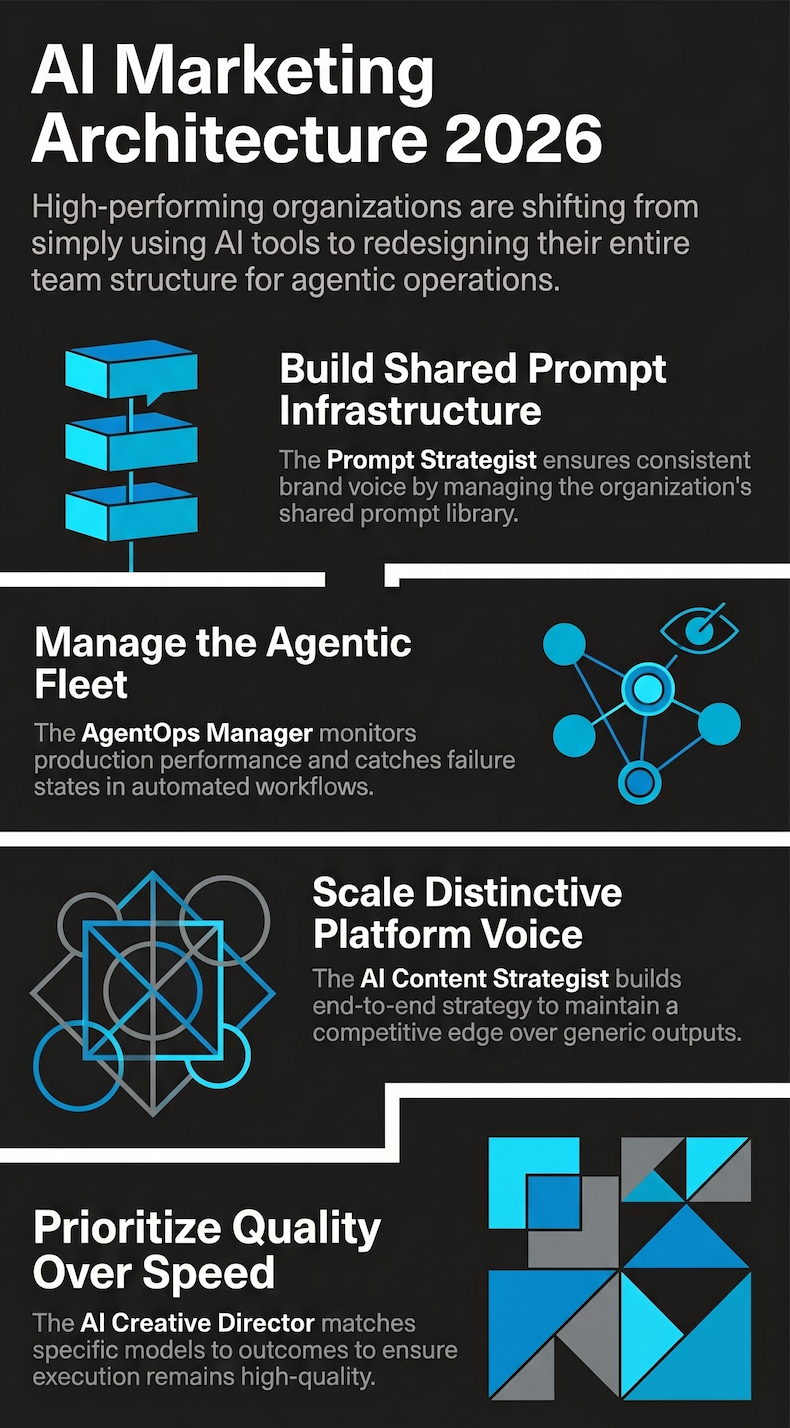
McKinsey's research reinforces why this structure matters: organizations that redesign workflows around AI — rather than simply adding AI to existing ones — are the same organizations reporting enterprise-level EBIT impact (McKinsey & Company, 2025). The high performers aren't buying different tools. They're running different operations.
WHY DOES A FRACTIONAL CMO ACCELERATE AI-DRIVEN GO-TO-MARKET STRATEGY FOR SAAS COMPANIES?
Most mid-market B2B tech and SaaS companies can't afford to learn this through expensive trial and error. They need a leader who has already seen what separates real transformation from expensive theater and can compress the timeline to get there.
The fractional CMO advantage in 2026 isn't about part-time bandwidth but pattern recognition.
An experienced fractional CMO for SaaS or B2B tech has operated across enough companies and industries to know which AI strategies drive pipeline — intent data infrastructure, agentic content workflows, GEO-optimized positioning and which ones produce impressive dashboards with flat revenue. They arrive with a tested playbook, not a hypothesis they'll refine on your dime.
For PE-backed and mid-market companies specifically, this means measurable pipeline impact within 90 days not a six-month strategy engagement before a single campaign launches.
WHAT IS THE COST OF IGNORING AI IMPLEMENTATION IN B2B MARKETING?
The implementation gap is compounding. The 5.5% of companies McKinsey identifies as true AI high performers are building advantages in workflow speed, pipeline generation, and marketing ROI that widen every quarter (McKinsey & Company, 2025). The 37% using AI at only a surface level are getting incrementally better at producing more of the same output — faster, cheaper, and with less differentiation than before.
If your pipeline isn't growing proportionally to what your marketing team is producing, that is the signal. Not that you need different tools but rather, a different thinking — and the leadership experience to make it stick.
The Economic Moat: Quantifying the "AI Fitness" Advantage
True competitive advantage is found in "AI-fit" companies that treat the technology as a core engine for business reinvention, creating an economic moat that becomes harder for competitors to cross with each passing quarter.
Here is what that looks like in practice:
→ Stop procuring tools. Start redesigning workflows. EBIT improvement is tied to how work gets done, not what software sits in your tech stack.
→ Rebuild your content strategy around Answer Engine Optimization. AI search engines are now the first stop for your buyers. Being cited is the new being ranked.
→ Bring in leadership that moves at market speed. An AI-first fractional CMO plugs in within days, not months diagnosing the gaps, eliminating wasted spend, and aligning your GTM motion to the revenue metrics your board tracks.
Contact GROW today to engage an AI-powered Fractional CMO who can unlock strategic orchestration and disciplined governance for your firm.
Want to get ahead of the line by figuring out where your gaps are? Start the Free 3-Minute Marketing Performance Assessment


Comments