

Why Are Smart CEOs Renting Marketing Leadership Instead of Buying It?
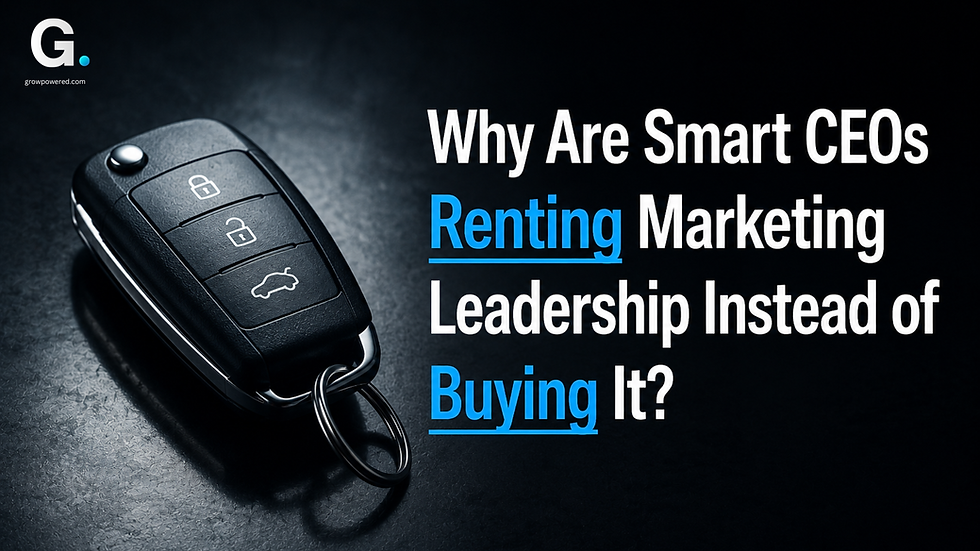
You bought the car for the long haul. Loved it in the lot.
Six months in, on the road you actually drive every day, it’s wrong.
Too much for the commute, not enough for the weekend trip. You start running the numbers on what you’d give to be in a lease, free to swap into something that fits the road you’re on.
Marketing leadership is that car. Most CEOs find out the same way, after they’ve already bought the ‘car’.
The good news: the signs show up early, and you have more options than the‘hire-or-don’t’ binary you think you’re stuck with.
The Seat You’re Most Likely to Regret Buying
The CMO is the most transient role in the C-suite, averaging about three and a half years, and closer to 19 months in tech, where the market moves fastest.
Roughly 42% of CMO hires are judged unsuccessful within 18 months. Marketing results are expected fast, and the role has the least standardized scope of anyC-suite seat, so when the fit is wrong you find out in two quarters, not two years.
Which means the smart move is to treat the role differently than every other seat at the table.
Four Signs You’ve Already Outgrown Your Marketing Hire
You can usually feel it before the data confirms it. Four signals, in plain terms:
1. Everything still routes through you. You’re approving campaigns and copy you hired someone to own. You quietly became the ‘de facto CMO’ again. Trust may have been eroded.
2. The team is busy and the number isn’t. Activity is high, but marketing’s contribution to pipeline is flat or impossible to attribute.
3. They’re great at the job you hired for, not the one you have now. They built the brand at $15M. At $50M you need a demand engine and a forecast, and that isn’t their game.
4. Nobody can draw the line from spend to pipeline to revenue. If marketing’s contribution to the number is a guess, you’ve either outgrown the seat or never filled it right.
One of these is a coaching conversation. Three of these are stage problems.
Match the Leader to the Stage, Not the Title
The instinct is to blame the search. Better recruiter, sharper interview. That misreads what happened. “CMO” is one title covering at least two different jobs.
Early and founder-led through roughly $10-20M, you need a builder.
Someone with their hands in the work: positioning, messaging, the first repeatable channel, the first real pipeline. Scaling from there toward $75M and beyond, you need an operator.
Someone who builds the demand engine, runs a team and a budget, and hands you a forecast you can take to the board.
Those are different people. Buying one and asking them to become the other is the most common and most expensive marketing mistake CEOs make. In a company that’s actually growing, the road changes faster than any single leader’s strengths can stretch to cover.
Buy, Lease, or Build: A 60-second Gut Check
Three real options, and a quick way to know which one you’re in:
Lease a fractional CMO when you’re moving between stages; pipeline needs senior ownership now, you can’t predict what the role will require in twelve months, or you’ve already churned one marketing leader. That’s most mid-market and PE-backed B2B tech companies.
Buy a full-time CMO when marketing is so fused with the product that it needs 40-plus hours a week of dedicated coordination, or your next raise contractually requires a full-time executive team. Then hire, and accept the ramp.
Build from within when you have a strong second-in-command who’s nearly ready. A fractional CMO can run the function and coach that person into the seat, so you grow your own leader instead of betting on an outside hire.
Leasing earns its place here through flexibility, not price. When your needs won’t sit still, the option to adjust is worth more than any discount.
What to Demand in the First 90 Days
A lease only pays off if you’re renting senior judgment, not cheap hours. Here’s the bar to hold any fractional CMO to, including ours:
First two weeks: a straight diagnosis of where pipeline actually breaks. Not a 90-day listening tour.
By day 30: a go-to-market plan your board can follow, and a clear call on the two or three channels worth funding.
By day 90: demand in motion and a pipeline forecast with marketing contribution named, not estimated.
The real test is simple.
Can they connect activity to pipeline to revenue, and will they tell you to stop doing something that isn’t working?
If all you get in 90 days is a polished deck, you leased the wrong thing.
This is how Grow runs a fractional CMO engagement: matched to the stage you’re in, re-matched as you scale, AI-driven go-to-market paired with a senior operator who knows how to point AI at real outcomes, accountable to pipeline and revenue from week one.
The Real Question for Your Next Board Meeting:
Stop asking whether you can afford a CMO. Ask whether you want to own a fixed asset in the one function that changes faster than any other in your company.
The CEOs pulling ahead kept their options open where the road changes most, and put senior leadership to work the week they needed it instead of the year after.
Then let’s talk: growpowered.com/contact-us
Read and subscribe to our newsletter for more insights: Subscribe on LinkedIn
Frequently Asked Questions:
How do I know if I’ve outgrown my CMO?
Watch for four signs: marketing decisions still route through you, the team is busy while pipeline stays flat, your leader is strong at the job you hired for but not the stage you’re in now, and no one can trace spend to pipeline to revenue. One of these is coachable. Several at once means the role has outgrown the person, which is common because marketing is the most stage-specific seat in the company.
What is a fractional CMO, and how is leasing marketing leadership different from hiring?
A fractional CMO is a senior marketing leader who works with your company part-time, embedded and accountable, without a permanent contract. Leasing the role means you get executive strategy now and keep the freedom to scale the engagement up, down, or out as your needs change, instead of locking into a fixed hire whose fit can expire in a couple of quarters.
Is a fractional CMO cheaper than a full-time CMO?
Yes. A full-time CMO runs $275K to $500K in total compensation, plus recruiting, ramp, and severance risk. A fractional engagement costs a fraction of that per month. The larger saving is avoiding a wrong permanent hire in the role most likely to be wrong.
When should a B2B SaaS or PE-backed company lease a fractional CMO instead of hiring one?
When you’re moving through growth stages quickly, pipeline needs senior ownership now, or you can’t justify locking into a permanent leader for a role whose requirements will change before the hire even ramps. That describes most mid-market and PE-backed B2B tech companies.
What should a fractional CMO deliver in the first 90 days?
A diagnosis of where pipeline breaks within the first two weeks, a go-to-market plan and a funded-channel shortlist by day 30, and demand in motion with a pipeline forecast by day 90. If all you get is a deck, you leased the wrong thing.
How does Grow match a fractional CMO to my growth stage?
Grow places a fractional CMO suited to where your business is today, embedded and accountable to pipeline and revenue, and adjusts the engagement as you scale into the next stage. The model pairs AI-driven go-to-market strategy with a senior operator, so a single leader can deliver the output of a full marketing function.


Comments